


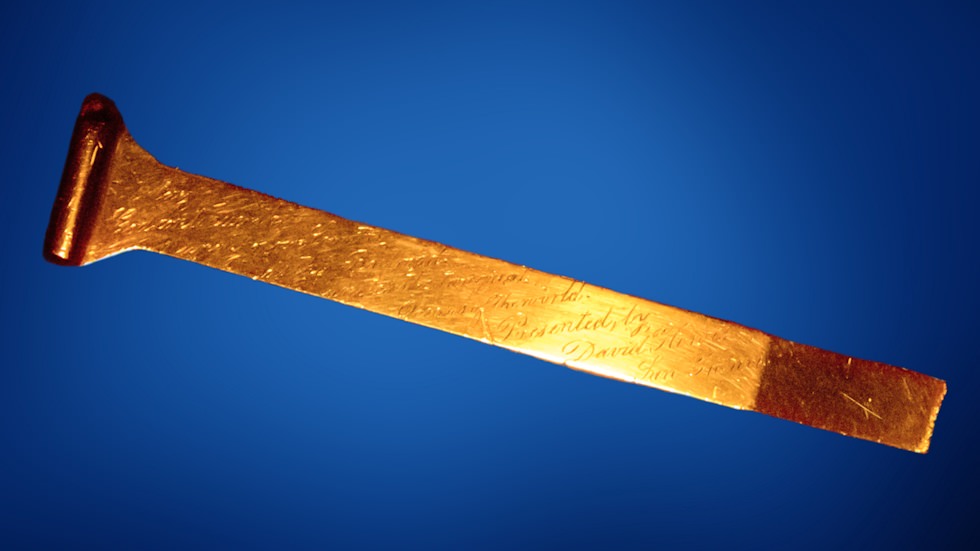
Photo by William E. Jennings. The original Golden Spike used to connect the Union Pacific and Central Pacific railways in 1869 near Ogden, Utah. This spike was driven in by Leland Stanford and is on display at the Cantor Arts Museum at Stanford University. This photo is licensed under the Creative Commons Attribution-Share Alike 3.0 Unported license.
by Brad Joseph (MCoR AP Chairman at the time of this article)
The Golden Spike is the easiest, and for many people, the first AP award that they earn. It is designed to demonstrate familiarity with different areas of the hobby, rather than expertise in a particular area. So take a look at the requirements – you may find that you have met most, or all of them already.
The subject of this Achievement Program column is the Golden Spike Award. As is the case with many features and components of the AP program, I feel the Golden Spike Award is misunderstood. Perhaps misinterpreted is the more correct description. At any rate, I hope to clear up some preconceptions and generate some enthusiasm for this certificate! Before I proceed however, there is a bit of housekeeping to be addressed.
First of all, my apologies to Clay Thompson of the Eastern Oklahoma Division. In my last column, I detailed the AP Certificates presented and I inadvertently left out Clay. Clay received his Volunteer Certificate last fall. Second, I want to welcome aboard Steve Shelton. Steve is a new NMRA member and has agreed to become the Eastern Oklahoma Division AP Chairman. This is a sign of great encouragement to me. Here we have a new member who not only wants to get involved and contribute to the hobby and organization, but also the AP program as well. He is a good example to us all. May I also suggest reading editor Bob Brown’s editorial in the most recent Narrow Gauge and Shortline Gazette discussing the AP.
Now back to the business at hand – the Golden Spike Award. Since 1994, there has been a marked decrease in the number of GS Certificates issued, and this has concerned me. I personally know many people who have started a layout over the past year or two and already achieved the necessary requirements for the award. Why don’t they apply?
I believe that there are a number of reasons for this problem. First, there are some model railroaders who, for whatever reason, will never be members. Perhaps they are “lone wolves” in the extreme, or perhaps they just don’t like organizations. Maybe they had a bad experience in the hobby. At any rate, I do not feel we will be successful in getting these types into the NMRA, and it is probably their loss. The second group are the people who have not been told about the program and the benefits it offers. Those should be the easy ones! All members should consider it their business to call appropriate layouts to the attention of others. The requirements are relatively simple, and most members can be familiar with them with a few minutes study. When we visit layouts on tours at meets, or run into people at hobby shops or swap meets showing photos of their layouts, speak up! Some personal contact and encouragement will do wonders. Get their name and phone number and ask if you may have someone contact them. Then have your Division or Area AP Chairman contact them. Follow up to make sure the connection comes off and we may have a convert! Even if the person is not a member, fill them in anyway as the possibility of the recognition of their modeling work may be a spark to recruit them.
The third group would be people who may not be enthused enough to fill out the paperwork. In this case, once again contact your Division AP Chairman to help arrange a visit or, better yet, set one up yourself. The verification signature on the Golden Spike form does not need to be an officer or even an official — it can be any member! There is no doubt in my mind that every MCoR member knows at least one person that qualifies for this award but has not applied for one reason or another. Let’s beat the bushes and get the general membership involved. If you know someone whose layout is close, encourage them to proceed on the features needed to qualify. Once they do, and get their award to hang in the layout room, I guarantee that they will thank you for the encouragement.
What does the award entail? It is pretty basic in its requirements and you will find that almost all but the most basic layouts qualify. There are 3 categories: Rolling Stock (Motive Power and Cars), Model Railroad Setting (Structures and Scenery) and Engineering (Civil and Electrical).
| Rolling Stock | A. Display 6 units either scratchbuilt, craftsman or commercial kits |
| Setting | A. Minimum of 8 square feet (any scale)B. Construct 5 structures which may or may not be part of the layout. They can be either scratchbuilt, craftsman or commercial kits too. |
| Engineering | A. Three types of trackage must be on proper roadbed and ballasted. Turnouts, crossings, crossovers, sidings, etc.B. Must be properly wired so two trains can operate at the same time. Blocks or command control will qualify. This is probably the most difficult requirement for the beginner.C. Must have one additional electrical or electronic feature in operation. This may be lights in a building, an operating crossing, or a horn or bell. |
There are a couple of extra points to keep in mind. First of all, in the Rolling Stock and Setting categories, if you build strictly commercial kits there must be some additional work done. Perhaps adding some details, weathering, repainting or decaling. Next, these features do not all have to be on the same layout or even be the same scale or gauge. Lastly, the three types of trackage do not have to be different. Three of the same item will qualify.
Not to tough is it? So first of all check to see if one is hanging on your wall. If not, drop me a note or a phone call and we will get you one quick. Next check all your friends. If they have earned it, they deserve it — let’s get them one too!


